Part 4 — Ted Bundy Criminal Psychology: The Escapes, the Sorority House, and the Trial


Carol DaRonch identified Bundy in an October lineup. A bench trial — Bundy waived a jury — ended in conviction for aggravated kidnapping. The judge noted Bundy’s “chameleon-like ability,” observing that his expression could so completely change his appearance that there were moments you were not sure you were looking at the same person.
But a cage could not hold him — or, more precisely, the system had not yet learned how dangerous it was to give this particular inmate access to an open window.
While awaiting trial for murder in Colorado, Bundy represented himself and was granted access to the Pitkin County Courthouse law library in Aspen. On June 7, 1977, during a recess, he opened a second-floor window and jumped approximately thirty feet to the ground. He was recaptured six days later, hobbling on a sprained ankle, driving a stolen car. Anyone watching might have concluded the lesson had been learned, the security tightened. They would have been wrong.
Over the following months at Garfield County Jail in Glenwood Springs, Bundy engineered a more meticulous escape. He lost approximately 35 pounds to fit through a ceiling opening. He acquired a hacksaw blade from fellow inmates, accumulated five hundred dollars smuggled in by an admirer named Carole Ann Boone, and sawed through steel reinforcing bars in his cell ceiling.
On the night of December 30, 1977, with a skeleton staff on duty over Christmas break, he piled books in his bed, climbed into the crawl space, navigated through plumbing passages, and broke into the chief jailer’s empty apartment directly above his cell. He changed into street clothes from the closet, walked out the front door, and disappeared. The jail did not discover the escape for more than 17 hours.
He traveled through Denver, Chicago, and Ann Arbor, Michigan, before arriving in Tallahassee, Florida, on January 8, 1978. He was a fugitive in a new state with a new identity, and for the first time in his killing career, the carefully maintained mask of self-control was disintegrating. What happened next was not the methodical predation of the Pacific Northwest — it was something more frenzied, more reckless, and more devastating.
One week after arriving in Tallahassee, in the early morning hours of January 15, 1978, Bundy entered the Chi Omega sorority house at Florida State University through a rear door with a faulty lock. What followed took approximately fifteen minutes. Using a piece of oak firewood, he moved through the darkened house room by room, attacking four sleeping women. Margaret Bowman, 21, was bludgeoned and strangled with a nylon stocking. Lisa Levy, 20, was beaten, strangled, sexually assaulted, and bitten deeply on her buttock and breast. Karen Chandler and Kathy Kleiner survived with shattered jaws, broken teeth, and skull fractures. Within the hour, he attacked a fifth woman, Cheryl Thomas, in a duplex six blocks away; she survived but was left permanently deaf in one ear. Sorority sister Nita Neary, returning home at approximately 3:00 AM, glimpsed a slender man carrying a log exit through the front door.
The forensic signature he left on Lisa Levy’s body — a clear, deep bite impression — would prove to be his undoing. But he was not done.
On February 9, 1978, Bundy abducted 12-year-old Kimberly Dianne Leach from Lake City Junior High School in broad daylight. She was his youngest known victim. Her partially decomposed remains were found nearly two months later near Suwannee River State Park. Kimberly Leach was a seventh-grader. She had gone back to her classroom to retrieve a purse she had forgotten. She never made it.
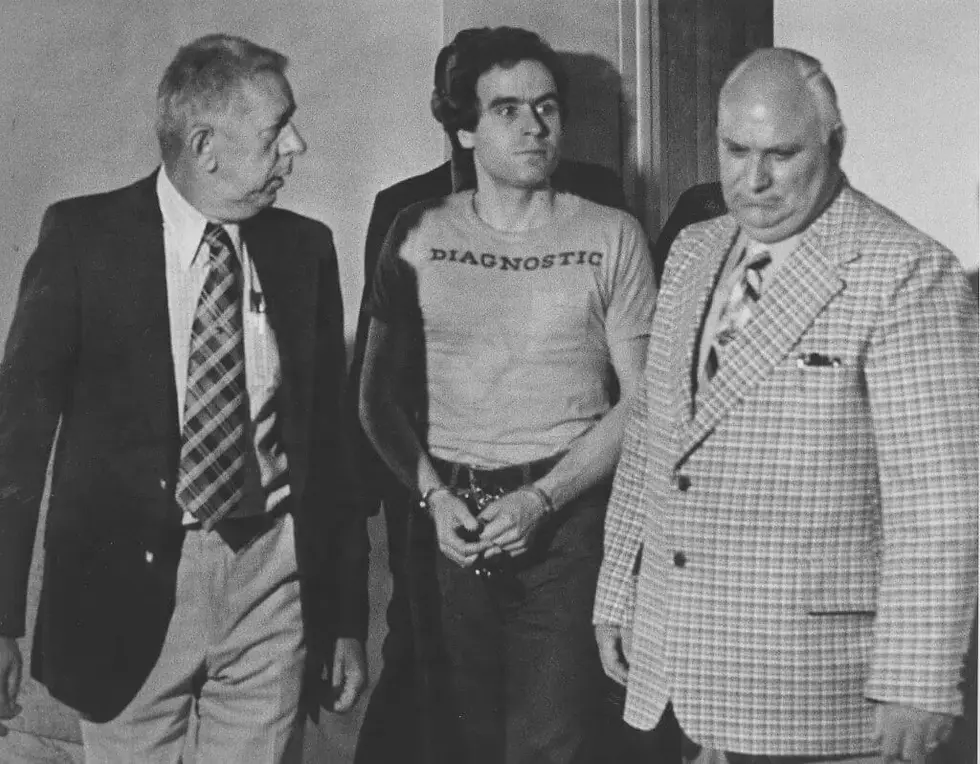
The Chi Omega trial began in June 1979 in Miami. It was the first criminal trial in American history to be nationally televised, covered by 250 reporters from five continents. Bundy handled much of his own defense despite having five court-appointed attorneys, firing and rehiring them, sabotaging strategic decisions, and treating the courtroom as a stage. His former attorney Polly Nelson later described his self-representation as driven by “spite, distrust, and grandiose delusion.” Another attorney, John Henry Browne, called it a fatally narcissistic miscalculation — Bundy believed he could charm and lie his way to acquittal.
The prosecution’s most devastating evidence was the bite mark on Lisa Levy’s body. Forensic odontologist Dr. Richard Souviron demonstrated that Bundy’s highly distinctive dental pattern — featuring chipped, misaligned, and irregularly spaced teeth — matched the wound. A transparent overlay placed over enlarged photographs showed a double bite: the attacker had bitten once, rotated, and bitten again. It was the first case in Florida history to use bite mark testimony as physical evidence linking a suspect to a victim.
The jury convicted in less than seven hours. Judge Edward D. Cowart imposed the death penalty and then addressed the defendant directly with words that captured the paradox at the heart of the case: he called the crimes extremely wicked, shockingly evil, and the product of a design to inflict a high degree of pain.
Then Cowart said something no judge had likely ever said to a convicted serial killer: “Take care of yourself, young man. I say that to you sincerely. You’d have made a good lawyer, and I would have loved to have you practice in front of me. But you went another way, partner.” It was an extraordinary moment — the judge articulating the precise split in Bundy’s nature that made him both fascinating and terrifying to the entire field of criminal psychology.
During the subsequent Kimberly Leach trial, Bundy exploited an obscure Florida statute by having Carole Ann Boone testify, then declaring their marriage from the witness stand with a secretly arranged notary public present to legalize the union. He had calculated, apparently, that no jury would sentence a man to death on his wedding day. The jury convicted in under ten hours and imposed his third death sentence. Boone bore a daughter, Rose, in October 1982, while Bundy sat on death row……………….
A Criminal Analysis by The Crime Ledger | Written by Karma Gray, Editor-in-Chief
Criminal psychology, criminology, and crime analysis — this is the second entry in The Crime Ledger’s Criminal Profile Series. This Ted Bundy criminal psychology analysis examines the developmental arc that the field of criminology has studied more than any other case in history. This is Part 4 of The Crime Ledger's criminal analysis of Ted Bundy. Part 5 traces the full psychological assessment record , the nature versus nurture analysis, the Dobson interview and pornography claim, the confession period, the execution, and the complete criminological legacy. For more criminological analyses, criminal psychology deep dives, and crime research by Karma Gray, visit crimeledger.org.


Comments